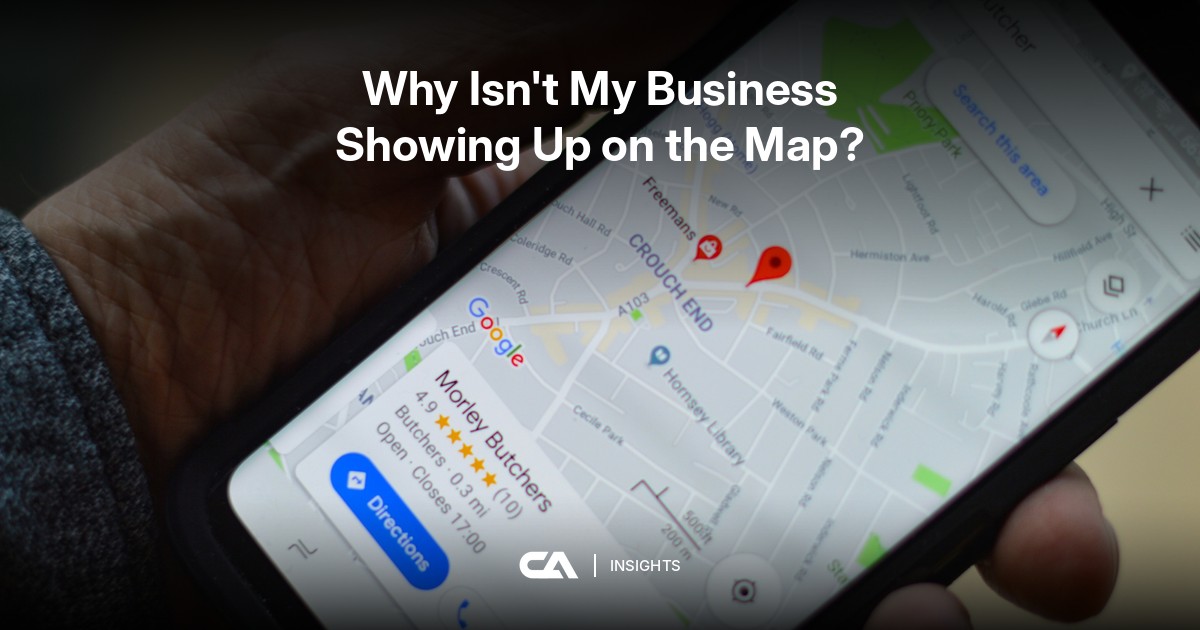
Why Isn't My Business Showing Up on the Map?
Most of your customers will decide about you without ever opening your website.
They search "roofer near me" or "best tacos Port St. Lucie." Google shows a map with three businesses pinned to it. They read a few reviews, tap "Call," and they're done. If you're not one of those three pins, you weren't in the running.
That map is called the local pack. Getting into it isn't luck, and you can't buy your way in. Google says so plainly: there's no way to pay for a better local ranking. What you can do is give Google fewer reasons to leave you out.
The three things Google is weighing
Google ranks local results on three factors. It has said this for years, and it still holds in 2026.
Relevance. Does your profile match what the person searched for? This comes down to your primary category, your services, and how clearly your profile describes what you actually do.
Distance. How close are you to the person searching? You can't change this one, and you shouldn't try. Moving your pin or listing a fake address is now one of the fastest ways to lose your listing entirely.
Prominence. How well known and trusted is your business? Reviews, review ratings, mentions around the web, and links back to your site all feed this.
The local search industry surveys experts every year on what moves the map. The 2026 results put Google Business Profile signals at roughly a third of the weight. Reviews came in around 20 percent, up from 16 percent in 2023. Your primary category and your distance from the searcher were the strongest single factors.
In plain terms: your profile and your reviews do most of the work. Your website matters, but it's not the main event here.
Why you might be missing
When a business doesn't show up, it's usually one of these.
The wrong primary category. If you're a bathroom remodeler listed as "General Contractor," you're competing for the wrong searches. Pick the category that matches the work you most want, not the broadest one available.
A half-finished profile. Missing hours, no services listed, no photos since 2021. Google rewards profiles that look cared for, because searchers do too.
Reviews that stopped. Twenty reviews from three years ago don't carry the weight of a steady trickle. Recency matters. A business that asks every happy customer for a review will pull ahead of one that asked once.
Inconsistent details. If your phone number or address is different on Yelp, Facebook, and your website, Google gets less confident about who you are. Clean these up once and they stay clean.
You got suspended and didn't notice. This one is new, and it's catching a lot of honest businesses.
The old tricks are now the fast way out
In April 2026, Google stepped up enforcement against spammy listings. It isn't a ranking update. It's a crackdown, and it's still running.
Practices that used to be common workarounds now trigger suspensions:
Stuffing keywords into your business name. "Smith Plumbing" is fine. "Smith Plumbing Port St. Lucie Emergency Drain Repair 24/7" is a red flag. Showing a home address on a service-area business. If you go to your customers, hide your address and set your service area by city or ZIP code instead. P.O. boxes and virtual offices. Google wants a real location with signage, or a properly set service area. Offering anything in exchange for reviews. Discounts, entries, freebies. Ask for honest reviews and leave it there. Editing everything at once. Changing your name, address, phone, and category in one sitting looks like a hijacked listing. Make changes one at a time.
Trades that get a lot of "near me" searches are under the closest watch: HVAC, plumbing, roofing, locksmiths, and similar. If that's you, check your listing now rather than after it disappears.
What I'd do this week
You don't need an agency to start. Set aside an hour.
Search for yourself the way a customer would. Use your service and your town, not your business name. Note who shows up in the three pins. Open your Business Profile and check the basics. Primary category, hours, phone, website, services. Fix anything wrong, one field at a time. Read your listing like a stranger. Would you call this business? Add recent photos of real work. Start a review habit. Text a short review link to every customer after a finished job. Reply to every review, good or bad. Match your details everywhere. Same name, same phone, same address on your website, Facebook, Yelp, and anywhere else you're listed.
If you work from home and travel to customers, make sure your address is hidden and your service area is honest. That single setting is behind a lot of the suspensions this year.
The bottom line
Proximity, reviews, accuracy. That's most of the local search game in 2026, and most businesses are skipping at least one.
The good news is that none of it requires tricks. It requires a profile that tells the truth, stays current, and shows that real customers trust you. That's work you can start today.
If you search for your own service and can't find yourself on the map, send me a screenshot. I'll tell you what I see and where I'd start.
Photo by henry perks on Unsplash.